
The Yamaha four-stroke range, from kicker to V8
Most Yamahas on this lake are four-strokes, and the range is wide. Small portables and mid-range fours on runabouts and pontoons share a straightforward layout: a single camshaft, a handful of plugs, one oil filter, one fuel filter. The offshore V6 and the 5.6-litre V8 are a different proposition altogether. More cylinders, more plugs, a heavier oil capacity, tighter cowling access, and an electrical system that expects a properly sized battery bank rather than whatever was cheapest at the store.
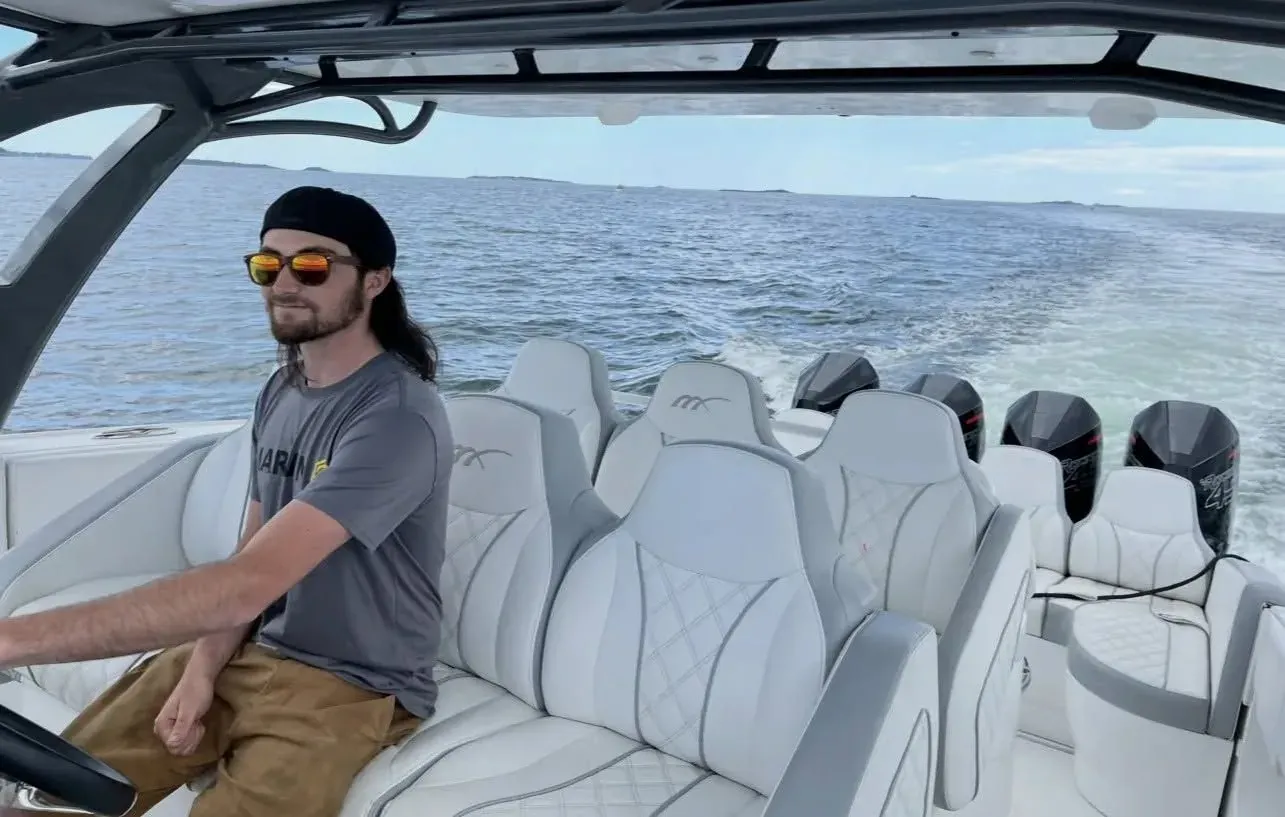
The V8s in particular turn up on large boats that spend their time at cruise rather than trolling, and they are frequently rigged in pairs, triples or quads. Weight and access change the work: cowlings come off, engines often have to be tilted or the boat repositioned, and a service that is an hour on a portable becomes most of a day across a big rig. That is worth planning around rather than being surprised by.
The annual pass
Oil and filter, gear lube, plugs, water pump, anodes and fuel filters is the shape of it, but the order and the detail matter. Yamaha four-strokes are particular about oil level, read on a level engine after it has sat, because an overfill will find its way somewhere it should not be. Plugs come out and get read as a set: one that looks different from its neighbours is information about that cylinder before it is a part to replace.
Anything beyond that comes from the engine's own service schedule for that model and serial number. Yamaha publish owner manuals and maintenance information through their outboard owner resources, and the requirements differ between the small fours and the offshore engines. We work to the manual for the engine in front of us. What we do not do is apply one generic list to every Yamaha on the lake, because valve clearance checks, timing components and drive-system items are not shared across the range.
The water-separating filter and the warning system
Yamaha fit a water-separating fuel filter with a sight bowl and a float, and checking it is the most useful five seconds of an owner's pre-launch routine. Water in the bowl is water that came out of the tank, and finding it there is far better than finding it in an injector. The filter element is a service item, not a permanent fitting, and on a boat that takes fuel from a variety of docks it earns its keep every season.
The warning system is the other thing owners misread. An overheat or low-oil-pressure warning puts the engine into a reduced-speed mode deliberately, to protect it. The correct response is to come off the throttle, check for telltale flow, and shut down, not to keep running in order to get home. An engine driven through a warning arrives at the shop with a different and far more expensive list of problems than one shut down the moment it complained.
Multi-engine rigs are not one service
Three engines is three oil changes, three gearcase drains, three sets of plugs, three water pumps and three sets of anodes. It is also three charging systems, three fuel paths and, on networked rigs, a control system that has to agree with itself about which engine is which. Faults that appear to belong to one engine, such as a lazy shift, a throttle out of step or a gauge reading nothing, often live in the harness or the network between them.
The advantage of a multi-engine rig is that the engines audit each other. Run the same checks across all of them and any outlier stands out immediately: one engine with lower compression, a cooler telltale, a darker gear lube, a plug reading differently from the rest. That comparison is free diagnostic information, and it is the first thing we use on a twin, triple or quad before anything gets taken apart.
Corrosion on a freshwater lake
Lake Winnipesaukee is freshwater. There is no salt, so the aggressive external corrosion that eats saltwater outboards is largely absent, and that leads owners to assume anodes do not matter here. They still do. Anodes protect against galvanic action between dissimilar metals and against stray current from shore power and from neighbouring boats in a marina, and a dock with poorly wired power can consume an anode surprisingly quickly even in fresh water.
The freshwater problems here are different in kind rather than absent. Water left in a gearcase or a cooling passage through a New Hampshire winter freezes and splits castings. A boat kept on a mooring off Tuftonboro all season grows the same biological film inside its cooling passages as anywhere else. Anodes get measured and replaced on condition rather than on faith, and cooling passages get drained properly before the first hard freeze rather than after it.