How galvanic corrosion works
Galvanic corrosion needs three things: two different metals, an electrolyte to carry current between them, and an electrical connection joining them. A boat supplies all three without anyone trying. The aluminium of a gearcase, the stainless of a propeller shaft, the bronze of a through-hull fitting, all bolted into one structure and all sitting in water. Once current flows, the less noble metal gives up material to protect the more noble one. It does not rust in the familiar orange sense. It dissolves, slowly, from the surface inward.
An anode is a deliberately chosen lump of metal that is less noble than everything else on the boat. Bonded into the same electrical path, it becomes the metal the current eats, and the gearcase, the trim rams and the propeller are left alone. That is the entire design. A pitted, half-consumed anode has not failed, it has been working. The failure state is the opposite: an anode still smooth and bright at the end of a season is usually not connected, painted over, or the wrong alloy.
The alloy has to match the water
Three alloys are in common use and they are not interchangeable. Zinc is the salt-water alloy. Magnesium is the fresh-water alloy. Aluminium is the brackish compromise and it also performs properly in fresh water, which is why a lot of manufacturers now fit it as standard. The difference is not marketing. Each alloy sits at a different voltage relative to the metals it protects, and each behaves differently in water of different conductivity. Fitting the wrong one is not a compromise, it is a boat with no protection at all.
Zinc is the specific trap. In fresh water a zinc anode passivates: it builds a hard pale oxide crust across its own face, that crust insulates it, and current output falls away to almost nothing. The anode looks fine. It stays intact and does nothing. A lake boat running factory zincs is effectively unprotected while its owner looks at an anode that appears barely touched and concludes everything is healthy. Lake Winnipesaukee is fresh water end to end, roughly seventy-one square miles of it with no salt anywhere in its twenty-one-mile length, so this applies to every boat on it.
Magnesium is the most electrically active of the three and gives the strongest protection in the low conductivity of fresh water. It is consumed fastest, so it wants inspecting more often, and it does not belong on a boat that spends part of its year in salt. Aluminium is the practical default for a boat that gets trailered somewhere brackish. Never mix alloys across one boat: the anodes then work against each other rather than against the corrosion. Colour is not a reliable guide, so read the casting marks.
Where the anodes live
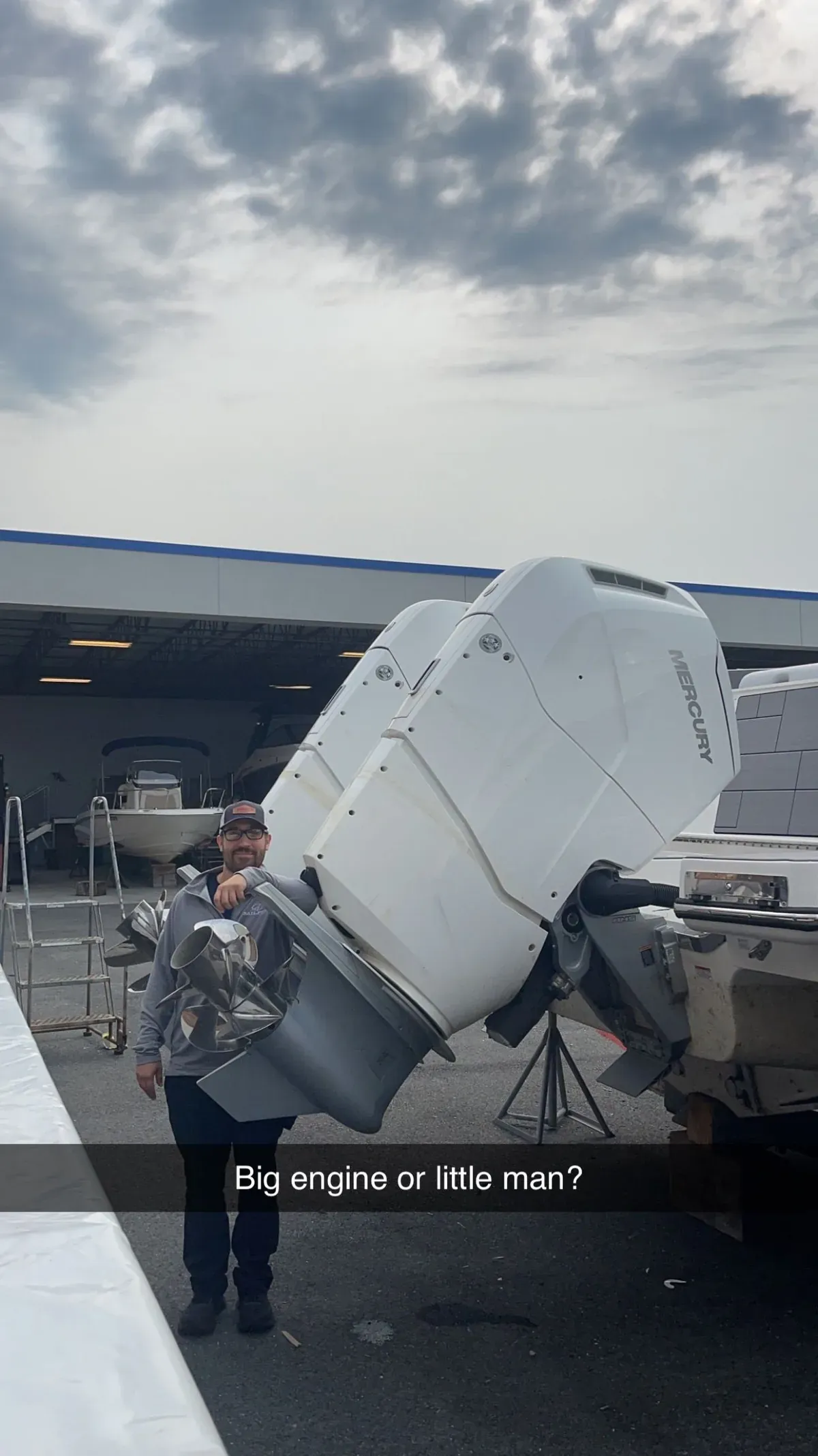
On an outboard the obvious one is the trim tab above the propeller, which is a working anode as well as a steering trim device. There is usually a plate anode on the gearcase, often anodes on the transom bracket and the trim cylinders, and on many engines an internal anode inside the cooling passages or the exhaust housing that never gets looked at. Missing one of the hidden ones is how a well-maintained engine still ends up with corrosion damage.
A sterndrive has more of them because it has more submerged assemblies: anodes on the drive itself, on the gimbal ring or transom assembly, on the trim cylinders, and often a ring or disc behind the propeller. A trailered boat sees far less exposure time and its anodes can last seasons, which sounds like good news and is the reason they get forgotten, painted over during a touch-up, or left corroded at the mounting face until they no longer make electrical contact.
Stray current is a different and worse problem
Galvanic corrosion is the slow background process. Stray-current corrosion is something else: an electrical fault pushing current through the water and out through the boat's underwater metal. The source is usually shore power, a wiring fault in a dock pedestal, a pump wired badly into the bonding, or a neighbouring boat on the same dock circuit. It is far more aggressive than galvanic action and can pit a gearcase badly inside a few weeks rather than a few seasons.
The signs are distinctive. Anodes that vanish in one season. White powdery bloom on aluminium castings. Paint lifting off a drive in sheets with clean metal loss underneath. Damage that is worse on one side of the boat, or that appeared only after the boat moved to a particular slip. No amount of new anodes fixes this, because anodes are not the problem. It needs electrical diagnosis of the boat and the dock circuit, and depending on what is found, a galvanic isolator or a correction to the shore-power earth path.
What to check, and when
Look at every anode at spring launch, again around midsummer, and once more when the boat comes out, which on this lake means whenever the marina you use sets its own haul schedule. Replace an anode once it is roughly half consumed rather than waiting for it to disappear, because its output falls as its surface area shrinks. Never paint an anode, and when fitting a new one, clean the mounting surface back to bare bright metal on both sides.
Check the fastener too. An anode only works if it is electrically continuous with the casting it protects, so a corroded stud or a dirty mating face quietly cancels the whole thing. Anodes disappearing unusually fast, or not wearing at all, is a diagnostic result in its own right and worth investigating before the next launch. If a drive is already showing pitting or paint lift, get it looked at while it is still a coating problem rather than a casting one.