
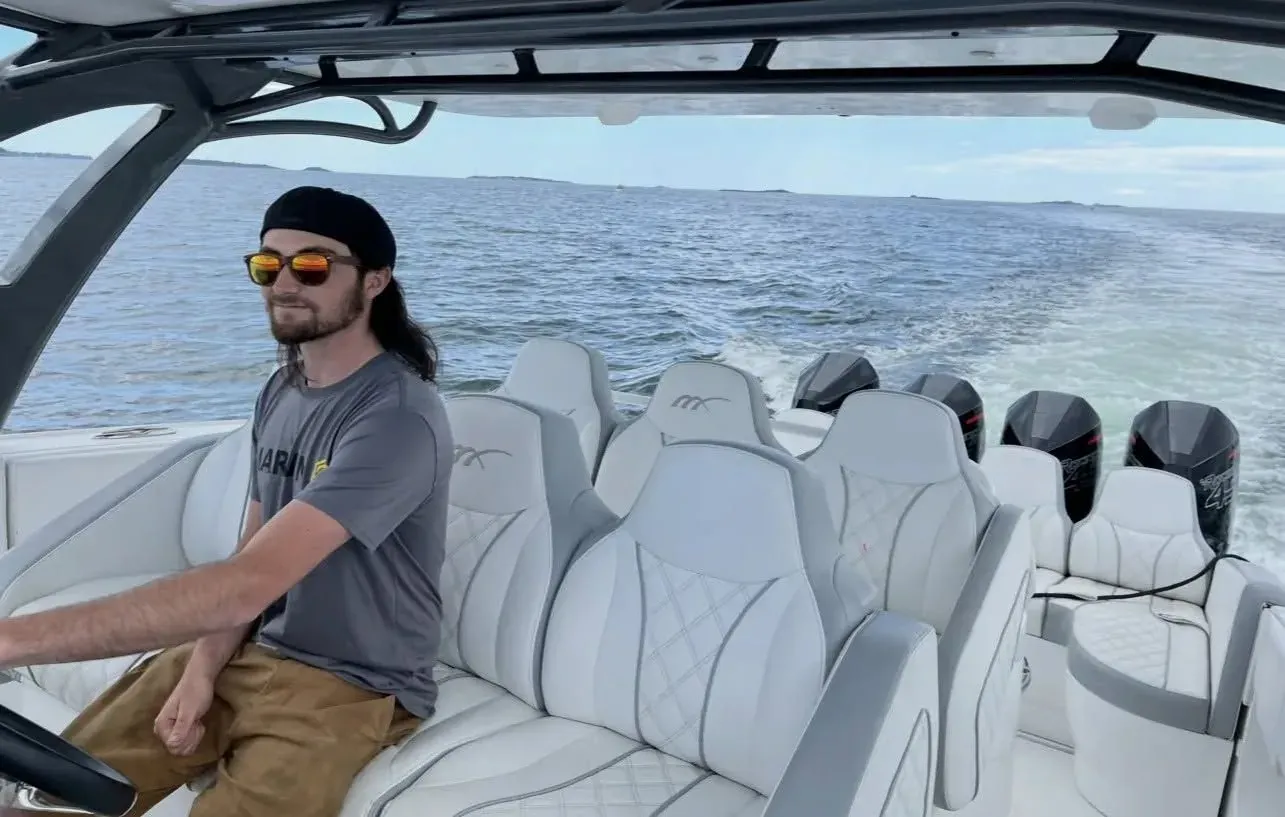
Two Mercury families under one badge
A Mercury outboard is a self-contained unit. Powerhead on top, midsection, gearcase at the bottom, the whole thing bolted to the transom and steering on its own bracket. Cooling water is drawn in through the gearcase, pushed up by a rubber impeller, and dumped overboard. A MerCruiser sterndrive is an automotive-derived engine sitting inside the boat, bolted to a transom assembly, driving a separate outdrive on the outside of the hull. Access, cooling, laying up and lifting are all different between the two.
That split matters when you book work. An outboard service is mostly fluids, filters and a gearcase. A sterndrive service adds a transom assembly with bellows and a gimbal bearing behind it, a raw-water path running through the block, and an engine bay that has to be worked in. Mercury's sterndrive maintenance overlaps heavily with Volvo Penta's, so the sterndrive-specific items are covered in detail on the sterndrive page rather than repeated here.
Annual service on a Mercury outboard
On a four-stroke the yearly pass is engine oil and filter with the engine warm and the leg vertical, gearcase lube drained and refilled with the drain and vent plug washers replaced, spark plugs out and read before new ones go in, the water pump impeller and housing inspected, fuel filters changed including the water-separating element, and anodes measured rather than glanced at. Linkages and the steering tube get greased. A two-stroke drops the oil change and adds attention to the oil injection system.
The engine's own service schedule sets what is due and when. We work to the manual for that particular model and serial number rather than to a generic list, because Mercury changes intervals and part numbers between families, and a supercharged Verado does not get the same pass as a small carburetted four-stroke. Mercury Marine publish owner manuals, maintenance schedules and support information on their own site, and it is worth an owner reading the one that matches their engine.
The gearcase and the water pump
The impeller is a rubber part living in hot water and it does not announce that it is finished. It hardens, the vanes take a set from sitting all winter in one position, and flow drops off long before an overheat alarm ever sounds. Pulling the gearcase to replace it also puts eyes on the driveshaft and prop-shaft seals, the shift shaft, the water tube grommet and the condition of the old lube coming out. That drain is a diagnostic, not just a fluid swap.
Fishing line is the other quiet killer. It wraps behind the prop, works its way past the seal and lets water into the gearcase, and on this lake it arrives from anywhere. Pulling the prop to look is a five-minute job that owners skip for years on end. Any lube that comes out grey, or with glitter in it, means the case comes apart rather than getting topped up and sent back out.
Digital throttle, SmartCraft and what they change about diagnosis
Newer Mercury rigs are not cable-and-gauge boats. Digital throttle and shift replaces the push-pull cables with a signal from the helm, and SmartCraft networks the engine, gauges, fuel senders and trim onto a common bus. The practical effect is that a fault which used to be mechanical is now sometimes a connector, a terminating resistor, or battery voltage too low for a network that will not tolerate it. A throttle that feels dead can sit in front of an entirely healthy engine.
Diagnosis on those systems starts with reading what the engine is already recording rather than guessing. Fault codes, run hours, voltage and sensor data come off the engine's own network, and they will often show that a problem happened at a particular load or temperature. That reading is also the fastest way to check a used boat's story. On older cable-controlled Mercurys the approach is more mechanical, but the principle holds: measure before replacing anything.
Where Mercury owners most often go wrong
The commonest mistakes are all small ones. Leaving the engine trimmed up for weeks so water sits in the gearcase and the exhaust. Flushing with the engine at an angle that will not let it drain. Reusing the sealing washers on the gearcase plugs and then blaming the seal when lube weeps. Ignoring a cracked anode because it still has material left on it. Running a battery flat over the winter and then cranking a fuel-injected engine on something that cannot hold voltage.
Fuel is the other one. Pump petrol here is usually E10, and ethanol holds water and goes stale in a tank that sits from October until ice-out. Winnipesaukee boats sit for close to half the year, and in 2026 ice-out was not declared until 13 April. A tank left part-full with untreated fuel across that stretch is the single most common reason an engine that ran perfectly in the autumn will not idle in the spring.